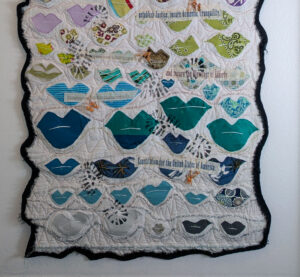
State of the Union is a powerful, tactile exploration of national identity, fragmented discourse, and the underlying skeletal structures of systemic state violence. At first glance, the quilt presents a vertical, somewhat chaotic spectrum of human expression, but a closer look reveals a meticulously layered commentary on the fragility—and the active erosion—of the American experiment.
The Visual Language of Speech
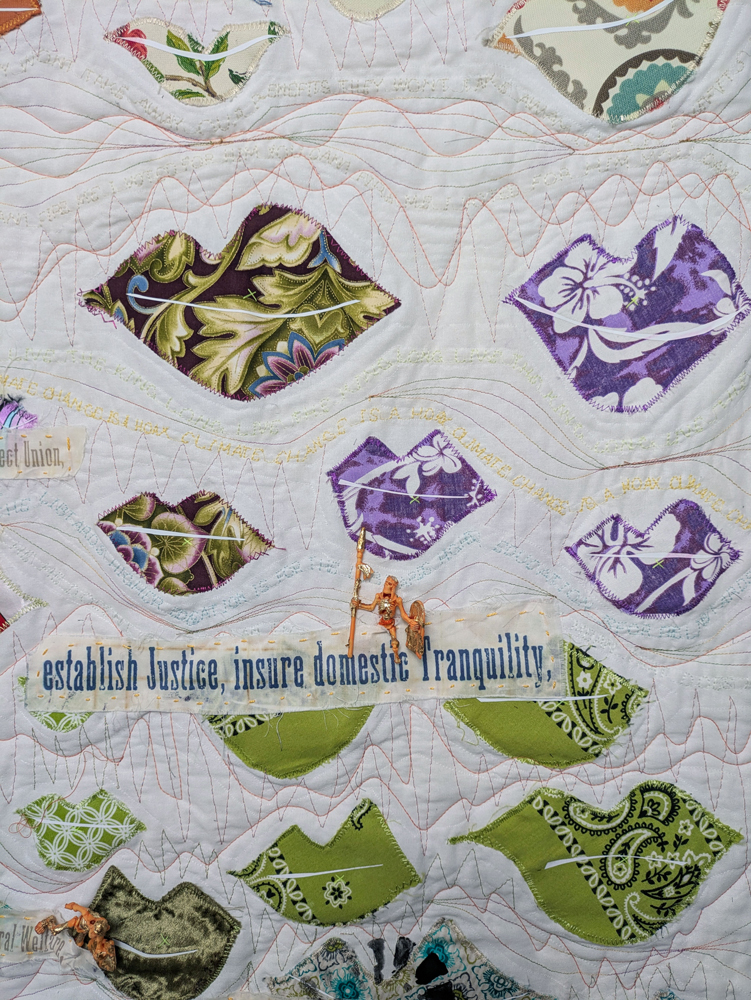
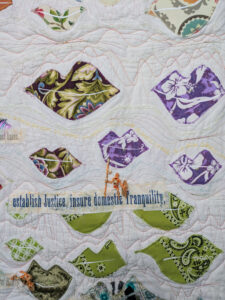
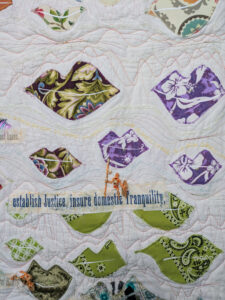
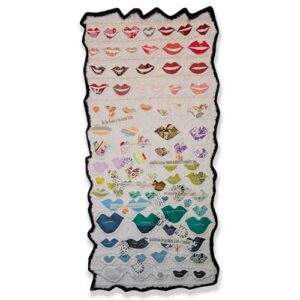
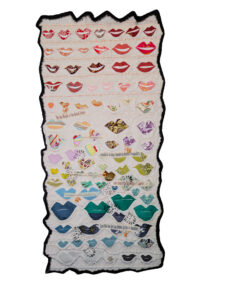
The most striking element is the repetition of the lips. Arranged in roughly ten horizontal rows, these stylized mouths transition from vibrant reds and warm pinks at the top to earthy greens, deep teals, and eventually ghostly grays and blacks at the bottom. The variety of fabrics used—ranging from polka dots and floral prints to solid, utilitarian blues—suggests a diverse “we the people,” a cacophony of different voices, classes, and backgrounds. Some mouths appear to be smiling, while others are set in a grim, flat line, creating a sense of a crowded room where everyone is speaking at once, yet the physical distance between the rows suggests a profound lack of communication.
The Fragile Foundation
Interspersed among these vocal rows are torn scraps of fabric bearing the text of the Preamble to the Constitution. These aren’t neatly integrated; they are attached with visible, hurried-looking hand sewing, making the foundation of the law feel like a patchwork repair job. Phrases like “We the People,” “establish Justice,” and “secure the Blessings of Liberty” drift across the quilt like echoes. By using torn scraps rather than a whole cloth, the artist suggests that the national contract is currently fragmented, undergoing a constant process of being ripped apart and tentatively stitched back together by those struggling to uphold it.
The Gilded Rot: A Regime Unmasked
The most haunting and pointed detail is the presence of the skeleton army men. Painted in a jarring, fluorescent orange and “sloppily gilded,” these figures serve as a direct critique of the Trump regime. The choice of orange is a visceral visual shorthand for the administration’s leader, while the “sloppy” gilding acts as a biting satire of the thin, poorly applied veneer of wealth and “greatness” used to mask the administration’s underlying brutality.
These skeletons are not merely soldiers; they represent the atrocities committed by ICE and the fascist-leaning members of the administration. By placing these skeletal enforcers between the rows of “vocal” citizens and the torn text of the Constitution, the artist highlights a grim reality: the state’s machinery was being used to hollow out the Union from the inside. They are the ghosts of a regime that prioritized performance and exclusion over human life, standing as a reminder of the human cost—specifically regarding immigration and state-sanctioned violence—hidden behind a gold-painted curtain.
Texture and Border
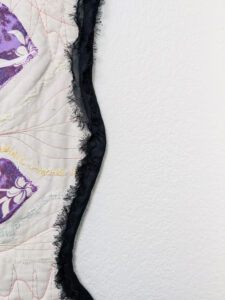
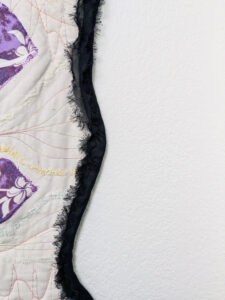
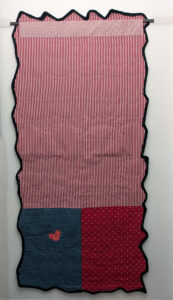
The quilt’s physical structure reinforces its thematic tension. The background is a white, heavily quilted surface with undulating stitch patterns that mimic sound waves or topographical maps. This softness is violently contrasted by the jagged, irregular black border. The perimeter looks scorched or frayed, suggesting that the “Union” is being burned at the edges or that the frame can no longer contain the internal pressures of the piece.
State of the Union is an exercise in textile irony. It uses the “soft” medium of quilting—traditionally associated with comfort and domestic stability—to broadcast a message of profound instability. Between the embroidered phrases (the “chatter” of the moment) and the gilded skeletons (the reality of the regime), the artist captures a nation that is both vibrant and decaying, held together by the thin, hand-sewn threads of its founding ideals while being haunted by those who sought to dismantle them.