
Paper Strata
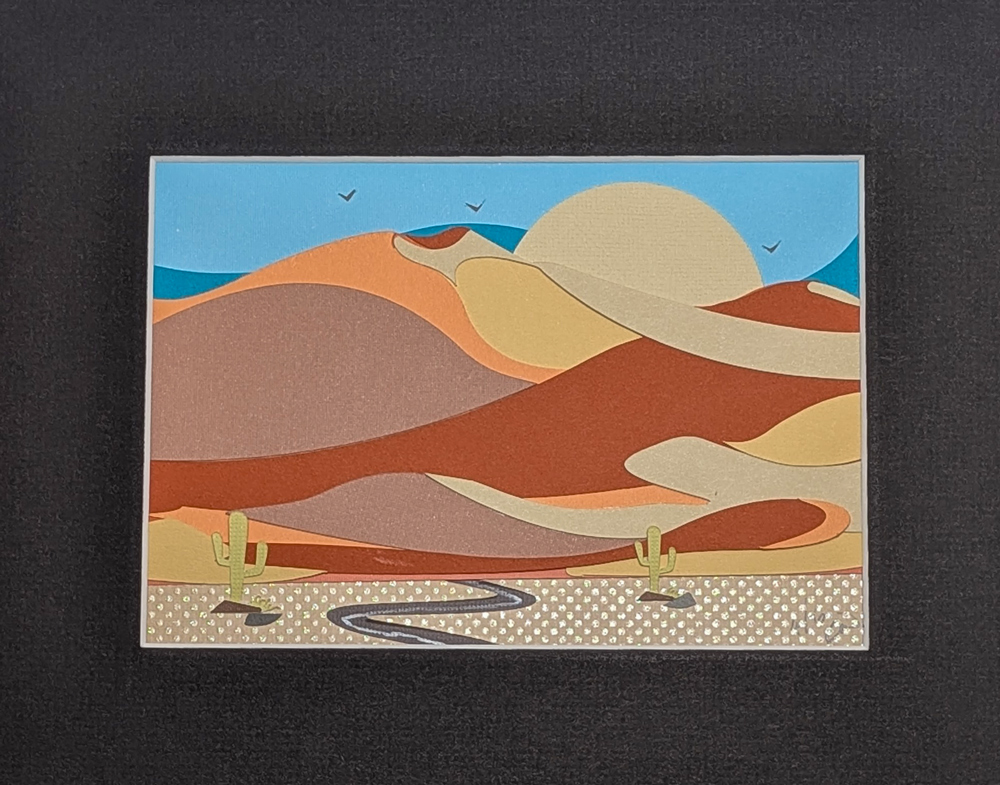
Cool Wind in My Hair Series
Tactile desert landscapes created through stacked paper layering. Features hand-cut saguaro silhouettes and vibrant, topographic mountain forms.
Paper strata art, also referred to as layered or dimensional cut paper, is a meticulous discipline that transforms a two-dimensional medium into a three-dimensional topographic experience.
By stacking multiple sheets of hand-cut or precision-cut paper, artists create a physical sense of depth, shadow, and geological movement. The core of this practice lies in the interplay between the void and the solid; each layer removed or added contributes to a complex visual narrative that shifts as the viewer’s perspective changes.
This technique is often used to replicate the organic rhythms of nature, such as rock formations, cellular structures, or topographical maps, where the cumulative thickness of the paper becomes a sculptural element in its own right.
The technical execution of paper strata requires a deep understanding of paper weight, grain, and structural tension. Artists must carefully select substrates that are acid-free and light-fast to ensure the longevity of the work, often opting for high-quality cotton rag or heavy cardstock that can withstand intricate cuts without tearing. The process is inherently additive and subtractive; the artist must pre-visualize how the lowest layers will interact with the highest points of the composition. Precise registration is critical, as even a millimeter of misalignment can disrupt the flow of the "strata" and collapse the intended optical illusion of continuous depth.
Beyond the geometry of the cuts, the success of layered paper art is heavily dependent on ambient lighting and the resulting cast shadows. Unlike traditional drawing or painting, where shadows are rendered with pigment, paper strata utilizes actual light to define its contours. As light hits the edges of the cut paper, it creates natural gradients and high-contrast lines that give the piece its "vibration." This reliance on the physical environment means the artwork is never truly static; the mood and intensity of the piece evolve throughout the day as the angle of light changes, highlighting the intricate handiwork and the delicate, fragile nature of the medium.
Ultimately, paper strata art is a study in patience and precision, bridging the gap between graphic design and sculpture. It invites the viewer to look closer at the transitions between levels, rewarding those who notice the subtle textures and the precision of the assembly. By elevating a common, everyday material like paper through repetitive layering and careful curation of space, artists are able to evoke a sense of monumental scale within a confined frame. The final work stands as a testament to the transformative power of a single material, turned into something complex and multidimensional through the simple act of layering.